
Defining a job profile correctly before starting a recruitment process can make the difference between hiring the right person or having to repeat the process due to a lack of clarity.
In many companies, the talent search starts with an urgent need: “we need to fill this vacancy.” However, when the profile isn’t well defined, the process often leads to poorly aligned candidates, lengthy interviews, delays in decision-making, and hires that don’t address the business’s real challenge.
A well-built job profile isn’t just an HR document. It’s a strategic tool that connects business needs, role responsibilities, required competencies, and evaluation criteria to select talent more precisely.
What is a job profile?
A job profile is a document that defines the purpose, duties, responsibilities, competencies, experience, and requirements needed to perform a role properly within a company.
It serves as the basis for recruiting, assessing, interviewing, hiring, and measuring a person’s performance in a specific position.
Why is it important to define a job profile before recruiting?
Defining a job profile before recruiting helps align the talent search with the business’s real needs.
When a company starts a process without clarity, it often attracts candidates who meet general requirements but don’t necessarily solve the position’s specific problem.
A well-defined profile helps to:
- Reduce hiring mistakes.
- Align expectations between HR and department leaders.
- Improve candidate quality.
- Design more objective interviews.
- Compare profiles using clear criteria.
- Speed up decision-making.
- Reduce turnover due to poor selection.
In strategic recruiting, headhunting, or executive search processes, the job profile serves as the starting point for understanding what kind of talent the organization truly needs.
Job profile, job description, and job analysis: are they the same?
Although they’re often used as similar concepts, they don’t mean exactly the same thing.
| Job profile | |
|---|---|
| What it defines Requirements, competencies, experience, and the ideal candidate’s characteristics |
What it’s for Recruiting, selection, and candidate evaluation |
| Job description | |
| What it defines Duties, responsibilities, tasks, and scope of the role |
What it’s for Internal management, performance, organizational structure |
| Job analysis | |
| What it defines A detailed study of the role, its activities, context, and demands |
What it’s for Building profiles, descriptions, and evaluation criteria |
The key difference is this: job analysis helps you understand the role, the job description documents what is done, and the job profile defines what kind of person is needed to succeed in it.
What should a job profile include?
A job profile should be clear, specific, and useful for decision-making.
It shouldn’t be limited to a long list of requirements. It should help identify which characteristics are essential, which are desirable, and how candidate fit will be evaluated.

1. Job title
The title should be clear, easy to understand, and aligned with the job market.
Example:
- Incorrect: Senior Integral Executive
- Better option: Senior B2B Sales Executive
- Better strategic option: Senior B2B Sales Executive for corporate accounts
An unclear job title can hurt candidate attraction, especially on digital job platforms.
2. Role purpose
The purpose answers a central question:
Why does this role exist within the company?
Example:
“The B2B Sales Executive will be responsible for developing new business opportunities with industrial companies, managing the consultative sales cycle, and contributing to the growth of the corporate client portfolio.”
This section should connect the role to a business objective.
3. Key duties and responsibilities
Duties should describe the role’s essential activities.
It’s recommended to prioritize 6 to 10 key responsibilities, avoiding long lists that mix operational, administrative, and strategic tasks without hierarchy.
Example:
- Prospect industrial-sector companies.
- Manage sales meetings with decision-makers.
- Gather customer needs and prepare proposals.
- Follow up on opportunities in the CRM.
- Coordinate technical visits with the operations team.
- Meet monthly targets for opportunity generation.
4. Experience requirements
Experience should be defined with realistic criteria.
It’s not enough to ask for “5 years of experience.” It’s important to clarify in what types of functions, industries, or contexts that experience should have been developed.
Example:
“Minimum 3 years of experience in consultative B2B sales, preferably in industrial services, technical solutions, maintenance, energy, manufacturing, or related sectors.”
This improves recruiting precision and avoids discarding relevant talent due to overly rigid criteria.
5. Education
Education should match the nature of the role.
In some roles, a specific degree may be essential. In others, experience, skills, and proven results may be more relevant.
Example:
For a regulated technical role, education can be critical. For a B2B commercial role, experience in negotiation, prospecting, and account management may matter more.
6. Technical competencies
Technical competencies are the knowledge, tools, or methodologies needed to perform the job.
Example for an HR Analyst:
- Competency-based interviewing.
- Knowledge of recruiting and selection processes.
- Use of ATS or candidate management platforms.
- Preparing candidate reports.
- Administering psychometric tests or technical assessments.
When a company manages multiple vacancies or needs to strengthen its recruitment process, it can rely on specialized models such as RPO to structure the search, evaluation, and presentation of candidates.
7. Soft or behavioral competencies
Soft competencies help assess how a person works, communicates, and adapts to the environment.
Example:
- Effective communication.
- Analytical thinking.
- Results orientation.
- Negotiation.
- Organization.
- Adaptability.
- Leadership.
- Emotional intelligence.
In leadership roles, these competencies can be as important as technical experience. That’s why some organizations complement their talent processes with executive coaching to develop leadership, communication, and decision-making.
8. Role success indicators
A strategic job profile should include how success in the position will be measured.
Example:
For an HR Manager:
- Average time to fill vacancies.
- Turnover of key staff.
- Internal leader satisfaction level.
- Training plan completion.
- Quality of hires.
- Progress on organizational culture projects.
This point helps connect the profile to performance management.
In roles related to payroll, administration, or compensation, indicators should consider accuracy, compliance, and operational efficiency.
9. Role conditions
Relevant working conditions should also be defined:
- Work mode: on-site, hybrid, or remote.
- Location.
- Schedule.
- Willingness to travel.
- Contract type.
- Salary range.
- Benefits.
- Reporting structure.
- Direct reports.

The clearer this section is, the lower the risk of attracting candidates who aren’t aligned with the role’s real conditions.
How to do a job profile intake correctly?
Job profile intake is the process through which HR, the department leader, and in some cases an external recruiting firm gather information to properly define a vacancy.
This step is key because it turns a general need into a clear, measurable, actionable profile.
Key questions for a job profile intake
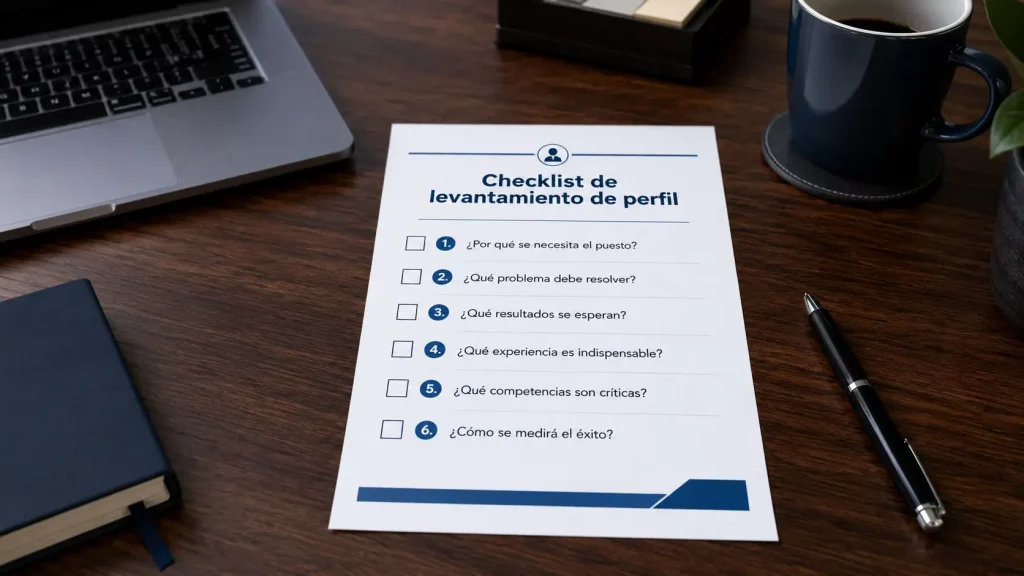
Before posting a vacancy, it’s worth answering these questions:
- Why does this position need to be filled?
- Is it a new position or a replacement?
- What business problem should this person solve?
- What will their main responsibilities be?
- What results are expected in the first 3, 6, and 12 months?
- What experience is essential?
- What knowledge is desirable but not required?
- What type of personality fits best with the team?
- Who will they report to?
- What level of autonomy will they have?
- What indicators will measure their performance?
- What mistakes have been made before when hiring for this profile?
These questions help avoid ambiguous profiles and improve the quality of the selection process.
Job profile example
Below is a simplified example of a job profile for a business position.
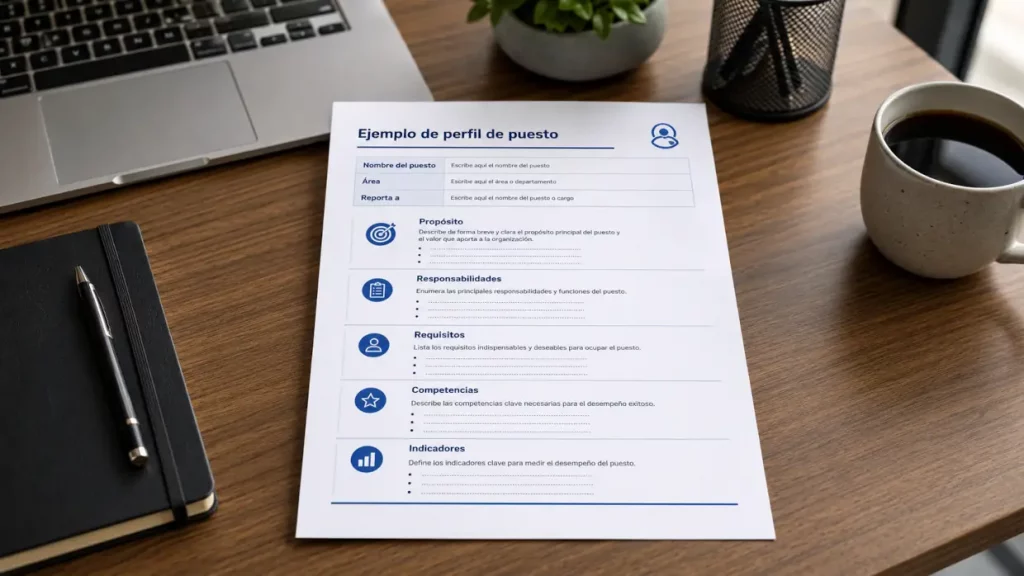
Example: Recruitment and Selection Coordinator
Job title: Recruitment and Selection Coordinator
Department: Human Resources
Reports to: Human Resources Manager
Location: Guatemala
Work mode: Hybrid
Role purpose
Manage recruitment and selection processes for administrative, commercial, and operational positions, ensuring the attraction of candidates aligned with business needs.
Key responsibilities
- Conduct job profile intake with department leaders.
- Post vacancies on job platforms.
- Screen résumés based on defined criteria.
- Conduct initial and competency-based interviews.
- Coordinate interviews with internal leaders.
- Follow up with candidates throughout the process.
- Prepare vacancy progress reports.
- Support onboarding processes.
Requirements
- Bachelor’s degree in Industrial Psychology, Business Administration, Human Resources, or a related field.
- Minimum 3 years of experience in recruitment and selection.
- Experience with competency-based interviews.
- Proficiency with job platforms and databases.
- Knowledge of recruiting metrics.
Competencies
- Effective communication.
- Organization.
- Internal customer focus.
- Analytical ability.
- Confidentiality.
- Follow-through.
- Sound judgment to assess candidates.
Success indicators
- Time to fill vacancies.
- Quality of candidates presented.
- Hiring manager satisfaction.
- Compliance with the selection process.
- Retention of hired candidates.
How to adapt the job profile to the type of vacancy?
Not all profiles should be built the same way. The depth of the profile depends on the level of responsibility, specialization, and hiring risk.
Operational roles
In operational roles, the profile should prioritize:
- Hands-on experience.
- Availability.
- Basic technical knowledge.
- Process compliance.
- Physical or schedule requirements, when applicable.
- Job stability.
Example: warehouse assistant, production operator, administrative assistant.
Administrative and professional roles
In these cases, the profile should balance technical knowledge, prior experience, and management competencies.
It should include:
- Tools they master.
- Processes they know.
- Required level of analysis.
- Relationship with other areas.
- Performance indicators.
Example: financial analyst, HR coordinator, sales executive.
Managerial or executive roles
In managerial positions, the profile should focus on strategic impact, leadership, and decision-making.
It should include:
- Role scope.
- Responsibility for teams.
- Budget ownership.
- Strategic indicators.
- Experience in transformation, growth, or change management.
- Expected leadership style.
Example: operations manager, commercial director, human talent manager.
Common mistakes when defining a job profile
A poorly defined profile can affect the entire recruitment process.
These are the most common mistakes companies make:
1. Copying old profiles without updating the real need
Many companies reuse previous job descriptions without validating whether the role has changed.
This creates outdated profiles, especially in areas where technology, processes, or responsibilities have evolved.
2. Asking for too many requirements
A profile with excessive requirements can unnecessarily reduce the number of qualified candidates.
Not everything needs to be essential.
It’s best to separate:
- Mandatory requirements.
- Nice-to-have requirements.
- Trainable competencies.
3. Not involving the department leader
HR can coordinate the process, but the department leader must provide clarity on expected results, role challenges, and team dynamics.
When the leader doesn’t participate, the risk of presenting candidates who don’t meet real expectations increases.
4. Confusing tasks with results
A task describes what a person does. A result defines what they must achieve.
Example:
- Task: post vacancies.
- Result: attract qualified candidates to fill vacancies within the expected timeframe.
A strategic profile should include both dimensions.
5. Not defining success indicators
If you don’t define how performance will be measured, it’s hard to know whether the hire was the right one.
Indicators make it possible to objectively evaluate the impact of the person hired.
6. Using generic language
Phrases like “proactive person,” “works under pressure,” or “excellent attitude” aren’t enough.
It’s better to translate those ideas into observable behaviors.
Example:
Instead of “proactive,” use:
“Ability to anticipate the team’s needs, propose solutions, and follow through without constant supervision.”
Best practices for creating a strategic job profile
A well-designed job profile should be useful for recruiting, interviewing, selecting, and evaluating.
These practices help raise the quality of the process:
Separate must-haves from nice-to-haves
Not all requirements carry the same weight.
Classifying criteria helps you make better decisions and expand the candidate pool without losing quality.
Example:
| Criterion | Classification |
|---|---|
| B2B sales experience | Must-have |
| CRM proficiency | Must-have |
| Experience in the industrial sector | Nice-to-have |
| Advanced English | Nice-to-have |
| Specialized technical knowledge | Trainable |
Define the role context
It’s not enough to say what the person will do. You also need to explain the environment they’ll work in.
For example:
- Is the company growing?
- Is the department being restructured?
- Does the role require building processes from scratch?
- Does the team need structure, leadership, or innovation?
- Is there pressure for commercial results?
This context helps identify candidates with greater adaptability.
Design interview criteria from the profile
The job profile should become a guide for interviewing.
Each important competency should have associated questions.
Example:
Competency: team leadership.
Question:
“Tell me about a time when you had to improve the performance of a low-motivation team. What did you do, and what was the outcome?”
Incorporate digital and analytical skills
In an increasingly data-driven business environment, many roles require digital skills, even when they aren’t tech roles.
Some increasingly relevant competencies are:
- Proficiency with digital tools.
- Analytical ability.
- Interpreting metrics.
- Use of CRM, ATS, ERP, or management platforms.
- Adaptability to automation and artificial intelligence.
- Data-driven decision-making.
This is especially important in sales, human resources, operations, finance, and customer service.
When these capabilities are integrated into a broader human talent management strategy, the job profile stops being an administrative requirement and becomes a tool for organizational evolution.
Practical table for defining a job profile
This table can serve as an initial guide to structure a profile before starting a recruitment process.
| Job title | |
|---|---|
| How is this role understood in the market? | Example: Human Resources Manager |
| Purpose | |
| Why does this role exist? | Example: Lead the talent strategy |
| Responsibilities | |
| What must they do? | Example: Recruiting, culture, performance |
| Expected results | |
| What must they achieve? | Example: Reduce turnover and improve time-to-fill |
| Experience | |
| What background do they need? | Example: 5 years leading HR departments |
| Technical competencies | |
| What must they know how to do? | Example: Metrics, payroll, labor law |
| Soft skills | |
| How should they work? | Example: Leadership, communication, judgment |
| Indicators | |
| How will success be measured? | Example: Turnover, engagement, time-to-fill |
| Conditions | |
| What must the candidate accept? | Example: Hybrid work mode, regional availability |
When is it worth relying on a recruiting firm?
A company can define many job profiles internally. However, there are situations where it’s worth having specialized external support.
This applies especially when:
- The vacancy is critical to the business.
- The profile is hard to find.
- Confidentiality is required.
- The internal process is overloaded.
- The company needs to benchmark candidates against the market.
- Executive or specialized talent is needed.
- There is high turnover in the position.
- There is no clarity on the ideal profile.
A recruiting firm can help not only find candidates, but also validate whether the profile is well defined, whether the salary range is competitive, and whether the requirements are realistic for the market.
If the vacancy is for executive roles, critical positions, or highly confidential profiles, it may also be advisable to activate a strategic headhunting process.
FAQ: frequently asked questions about job profiles
What is a job profile?
A job profile is a document that defines the requirements, duties, competencies, experience, and characteristics needed to properly fill a position within a company.
What is the difference between a job profile and a job description?
A job description focuses on duties and responsibilities. A job profile defines what kind of person is needed to perform those duties successfully.
How do you create a job profile?
It’s created by conducting a job profile intake with the department leader and defining the role purpose, duties, requirements, competencies, success indicators, and working conditions.
What should a job profile include?
It should include the job title, purpose, duties, responsibilities, experience, education, technical competencies, soft skills, success indicators, and role conditions.
Why is job profile intake important?
Because it helps you understand the business’s real need before starting the candidate search. A good intake reduces errors, improves candidate quality, and speeds up the selection process.
Who should define the job profile?
It should be built jointly by HR, the requesting department leader, and, when applicable, an external recruiting or headhunting firm.
What happens if the job profile is poorly defined?
A poorly defined profile can lead to poorly aligned candidates, unproductive interviews, hiring delays, early turnover, and wasted time for the company.
How often should a job profile be updated?
It should be reviewed whenever responsibilities, tools, department structure, business objectives, or labor market conditions change.
Conclusion
The job profile is a strategic tool for making better hiring decisions.
When a company clearly defines what it needs, what results it expects, and which competencies truly matter, the recruitment process becomes more precise, agile, and effective.
Before posting a vacancy, interviewing candidates, or starting a headhunting process, it’s worth investing time in properly defining the job profile. That initial clarity can prevent costly mistakes and improve the quality of talent brought into the organization.